This entry was originally posted on Friday, October 19, 2012

Keep the reflection of an object in water a bit softer and with
softer lines than the object itself.
That way it will look more like a reflection rather than the
actual object.
This entry was originally posted on Friday, October 19, 2012
Keep the reflection of an object in water a bit softer and with
softer lines than the object itself.
That way it will look more like a reflection rather than the
actual object.
This entry was originally posted on Thursday, October 18, 2012

20x30"
Reflections
in water are lighter with a dark object and darker with a light object.
This entry was originally posted on Wednesday, October 17, 2012

7x10"
When
painting water, remember that the water reflects the sky.
This entry was originally posted on Saturday, October 13, 2012

When
painting plein air, don't forget the water!
I
recently found this wonderful water container to carry my water in.
It
has a hook on it so I can hang it off the handle of my carrying bag.
The
best part about it is that it does fold up on itself so I can easily toss it
into just about any bag or backpack while traveling.

This entry was originally posted on Friday, October 12, 2012

One
way to reduce "stuff" and keep your plein air kit lightweight is to
have portable water containers.
These
containers are collapsible and have a handle to hang off the side of your
easel.
This entry was originally posted on Wednesday, September 5, 2012

Drybrush
is also a great and easy way to create sparkles on the water.
This entry was originally posted on Monday, July 2, 2012

One way to create sparkles on the water is to use masking fluid
before you begin painting.
Another way to create the sparkles is to use an x-acto knife at
the end.
Just gently scratch the surface of the paper so it scratches
away the paint.
Be careful not to scratch so hard that it cuts your paper
though!

This entry was originally posted on Friday, June 29, 2012

In
watercolor, you usually save your whites.
However,
white paint can be used at times.
I
have mentioned the past couple of posts, the use of white for snow and crashing
waves.
White
paint can also be used to create more dimensions to calmer waves.
It
also creates an opaqueness to the water that can sometimes be seen when light
reflects off of it.

This entry was originally posted on Friday, January 27, 2012.
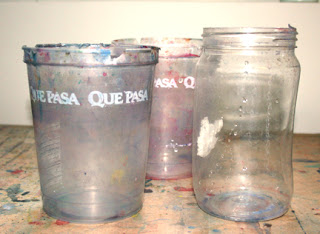
Quite often I see students bring in their containers of water for my classes.
They are usually these pathetic little tubs that barely hold a cup of water.
Or I see them struggling with these large ice cream buckets (you know the ones- the big gallon containers)
I find that neither of these work.
First of all, the water in little container get dirty so quickly that you are either painting grey paintings or you need to refill it every few minutes.
The big gallon ones are great if you don't want to get clean water often but it takes up so much room on your table that you don't know where to put your painting. Plus it is more awkward to carry.
My suggestion is to use a container that is only about a 4 cup size (or 750-800ml)
like an empty peanut butter or yogurt container.
Not too small and not too big.
Just right.
